Showing posts with label LASIK. Show all posts

Monday, December 28, 2015

2016.VISUMAX Lanch


We are going to lauch VISUMAX in 2016. There are introduction of Vusumax system
 
VisuMax Femtosecond System
Defining the pulse rate in refractive surgery
With the VisuMax®, ZEISS is significantly shaping the world of refractive surgery. This ground-breaking laser system employs high-performance femtosecond laser technology and is characterized by its outstanding cutting precision, unsurpassed speed and gentle treatment technique. The VisuMax is thus the ideal platform for therapeutic and refractive applications of cutting-edge corneal surgery, including:

Flap - for precise flap cutting for Femto-LASIK and PRESBYOND Laser Blended Vision
Keratoplasty - for a broad spectrum of corneal transplant procedures
Incision for ICR - for tailor-made intracorneal tunnel segments
ReLEx - the step towards minimally invasive laser vision correction

With ReLEx®, VisuMax heralds a paradigm shift in refractive surgery: minimally invasive laser vision correction. It completes the unparalleled range of innovative surgical possibilities and creates the ideal preconditions for tapping into new patient groups.
VisuMax is the logical enhancement of the product range for refractive surgeons – and marks another step into the future of corneal surgery, the progress of which ZEISS has been shaping for more than 20 years.

** souce: http://www.zeiss.com/meditec

★Free Eye Exam and Consultation Request★
http://bit.ly/1D8nyFt
For more information, refer to the following pages.
English website: http://www.visionclinic.co.kr/eng
Facebook page: https://www.facebook.com/lasikinkorea
MOON JOO KIM
Kangnam Joeunnun International Eye Center
y0613v@hanmail.net
Tel: 02-535-8001 / 010-7793-8003


Sunday, November 29, 2015

Kendrick's LASIK experience

Name: Kendrick
nationality: singapore
Surgery: 2015.11.7 Z2 femtosecond All Laser LASIK


1. What convinced you to go through with the surgery? And what made you choose this Clinic?
My friend recommended me to this clinic and I was convinced of the doctor’s ability after he explaned to me.

Seeing the certificates in the lobby reassumed me of the doctor’s ability as well.

2. Tell us about what has changed since you had your surgery. What are the major changes, comparing your life before and now after, the surgery?

It feel great without having to look for my glasses when I wake up everyday. Everything is so clear.


3. Were there any inconveniences during the recovery process? Tell us about how satisfied you are with your newly improved vision.

None. Everything went smoothly. I am extremely satisfied with the outcome of the surgery.


4. What were the most valuable and memorable experiences at Joeunnun Eye Clinic?

The doctor,nurse were very kind and polite,answering all my doubts and assisting me in any problem that I have


5. Finally, what else do you want to tell us (our medical staff, doctors, and nurses)? Anything is OK, including some of your ideas that may help  us to improve ourselves.

I wish to thank them for their patient and kind assistance. Special thanks to Ms.Moon Joo for treating me so well. Everything is perfect.


Thursday, November 26, 2015

Protecting Your Eyes from Solar Radiation

The sun supports all life on our planet, but its life-giving rays also pose dangers.

The sun’s primary danger is in the form of Ultraviolet (UV) radiation. UV radiation is a component of solar radiation, but it can also be given off by artificial sources like welding machines, tanning beds and lasers.
Most are aware of the harm UV radiation can do to the skin, but many may not realize that exposure to UV radiation can harm the eyes or that other components of solar radiation can also affect vision.
There are three types of UV radiation: UV-C is absorbed by the ozone layer and does not present any threat; UV-A and UV-B radiation can have adverse long- and short-term effects on the eyes and vision.
If your eyes are exposed to excessive amounts of UV radiation over a short period of time, you are likely to experience an effect called photokeratitis.

Like a “sunburn of the eye”, photokeratitis may be painful and include symptoms such as red eyes, a foreign body sensation or gritty feeling in the eyes, extreme sensitivity to light and excessive tearing. Fortunately, this is usually temporary and rarely causes permanent damage to the eyes.
Long-term exposure to UV radiation, however, can be more serious. Scientific studies and research have shown that exposure to small amounts of UV radiation over a period of many years increases the chance of developing a cataract and may cause damage to the retina, a nerve-rich lining of the eye that is used for seeing. Additionally, chronic exposure to shorter wavelength visible light (i.e. blue and violet light) may also be harmful to the retina.
The longer the eyes are exposed to solar radiation, the greater the risk of developing later in life such conditions as cataracts or macular degeneration. Since it is not clear how much exposure to solar radiation will cause damage, the AOA recommends wearing quality sunglasses that offer UV protection and wearing a hat or cap with a wide brim whenever you spend time outdoors. Also, certain contact lenses can provide additional UV protection.
To provide adequate protection for your eyes, sunglasses should:
  • block out 99 to 100 percent of both UV-A and UV-B radiation;
  • screen out 75 to 90 percent of visible light;
  • be perfectly matched in color and free of distortion and imperfection; and
  • have lenses that are gray for proper color recognition.
The lenses in sunglasses should be made from polycarbonate or Trivex® material if you participate in potentially eye-hazardous work or sports. These lenses provide the most impact resistance.
If you spend a lot of time outdoors in bright sunlight, wrap around frames can provide additional protection from the harmful solar radiation.
Don’t forget protection for children and teenagers. They typically spend more time in the sun than adults.
Be sure to see your doctor of optometry at least every two years [recommended schedule of examinations] for a comprehensive eye examination. It is a good way to monitor your eye health, maintain good vision and keep track of your solar radiation protection needs as well as new advances in eye protection.


** souce:http://www.aoa.org/patients-and-public/caring-for-your-vision/uv-protection?sso=y

Sunday, November 1, 2015

Z4 SCOUT LASIK


The staffs were friendly and helpful, Doctor seemed to competent and gentle.
 I was mildly off put by the giggles from surgical support staff who fumbled and dropped equipment and were seemingly inept at adminstering analygisic eye drops before the surgery. The surgery was comfortable even though I was a bit worried about my eyes However considering that lasers were cutting holes through my eyeballs It was surprisingly minor procedure.All in all regarding the surgery, It was quick, relatively painless and the doctor seemed competent.I would have consider this a fantastic procesure,  However unfortunately as the anesthesis were off the pain became so excruciating that my eye muscles bagan to spasm continuely. I was concerned that this contractions may have affected the healing prrocess and the outcome of the surgery.
what irks me is that the simple prescription of the anelgesic eyedrops, or a single dose of a muscle relaxent, or an opite would have mitigated the contractions releaved the pain and allow the patient to sleep through the healing process.
 Now after 1 month, My eyes are getting better and I am very happy with the result that I could see better without glasses,  Thank you for the help and wish to be your business goes well.

  * Like what I said. I think because every person has different level of pain nervs, It would help the patients more if they would have proper medicines for after surgery. 

Wednesday, October 14, 2015

5 Foods for Healthy Eyes


You've probably heard that carrots and other orange-colored fruits and vegetables promote eye health and protect vision, and it's true: Beta-carotene, a type of vitamin A that gives these foods their orange hue, helps the retina and other parts of the eye to function smoothly.

But eating your way to good eyesight isn't only about beta-carotene. Though their connection to vision isn't as well-known, several other vitamins and minerals are essential for healthy eyes. Make these five foods a staple of your diet to keep your peepers in tip-top shape.


Leafy greens

They're packed with lutein and zeaxanthin—antioxidants that, studies show, lower the risk of developing macular degeneration and cataracts.

Eggs

The yolk is a prime source of lutein and zeaxanthin—plus zinc, which also helps reduce your macular degeneration risk.

Citrus and berries

These fruits are powerhouses of vitamin C, which has been shown to reduce the risk of developing macular degeneration and cataracts.

Almonds

They're filled with vitamin E, which slows macular degeneration, research shows. One handful (an ounce) provides about half of your daily dose of E.

Fatty fish

Tuna, salmon, mackerel, anchovies and trout are rich in DHA, a fatty acid found in your retina

**source:www. health.com

Tuesday, August 11, 2015

LASER EYE SURGERY PROMOTION IN KOREA


Without your glasses or contacts you will be free to Swim, run and free to play, free to live your life.
Kangnam Joeunnun International Eye Clinic is offering a huge promotion on All-Laser Eye Surgery throughout this summer. If you have questions about the eye surgery procedure and its cost, please contact us by visiting our website or via contact information below.

 ★Free Eye Exam and Consultation Request★
http://bit.ly/1D8nyFt
For more information, refer to the following pages.
English website: http://www.visionclinic.co.kr/eng
Facebook page: https://www.facebook.com/lasikinkorea

MOON JOO KIM
Kangnam Joeunnun International Eye Center
y0613v@hanmail.net
Tel: 02-535-8001 / 010-7793-8003


Wednesday, July 22, 2015

WHY CHOOSE US?


                                    WHY CHOOSE US?


We give you the aftercare service since the care after surgery is as much important as the surgery.
In addition we guarantee that we will take care of your eyes in your lifetime after you have refractive surgery at our hospital. And although if you need additional surgery related to your previous surgery you will not be charged for it. Also we are comfortable giving you the data of preoperative exam and surgery so that you will be able to get medical treatment from another eye hospital near your house as well.

Monday, July 6, 2015

Julie's LASEK STORY

                
                      Julie's LASEK STORY


My LASEK experience actually started off as a favor to a friend.  I was 35 years old and had worn glasses since I was 12, so almost a third of my life.  I had thought about getting LASIK or LASEK a few times but because I had poor eye sight and because of my age I figured I wouldn’t be a candidate so I just forgot about it.  Then came the day my friend asked me to go with her to Gangnam for an eye appointment.  Not only did I agree, I asked her to make an appointment for me too.  Korea is a greatplace to get the surgery done as it is fairly cheap but still has a high quality of service.

Now that I had decided to at least do an initial consultation, deciding what clinic to go to was another question.  Together my friend and I looked online at various blogs, websites, and ads.  They all offered the same services and prices and there were so many to choose from we were getting overwhelmed.  We made appointments at a few different clinics around the Gangnam Station area as we were travelling from Suwon so wanted something not too hard to get to.  We went to these clinics over a couple weekends and in the end I chose Joeunnun Vision Clinic.  This clinic was actually the least well-known to us based on our Internet research but they won me over.  Their service is excellent, as well as their prices but what really sealed the deal was their equipment.  They had the most up-to-date equipment on the market, which was safer and more effective.  While the other clinics also had great services and prices, their equipment was one generation behind that of Joeunnn Vision Clinic and since they were going to be messing with my eyes…I wanted the best.

When we arrived at the clinic, the staff were friendly and professional.  They had one of their English speaking staff members help me fill out the forms and then off we went for an hour-long barrage of tests.  At the end of all the tests, came the personal consultation with a clinic representative who went through the options.  It turns out that I was able to do either LASIK or LASEK because I had thick corneas and although my vision was REALLY bad with high myopia, I had low astigmatism.  They suggested LASEK as my safest option and the best bet for 20/20 vision.  I agreed with their assessment as LASEK doesn’t produce a permanent corneal flap (unlike LASIK) which could potentially be displaced in the future, it is less likely to exacerbate eye dryness, and uses less of the cornea.  This last one was a deciding factor for me because I knew there was a risk of regression and wanted enough cornea remaining in case I needed to have another surgery in the future.  The downside of LASEK is that there is pain for the first few days after the surgery and it takes time for your vision to improve to the desired result.
You are able to have your consultation and surgery all in the same day as long as you have made an appointment beforehand but since I had decided on LASEK, I knew I would need more than a weekend to heal so I made my appointment for the winter break when I would have a week to lay in bed and relax. 

It is now 6 months after my surgery.  I have just had my final monthly checkup and was told to come back in 3 months for a regular checkup.  I have better than 20/20 vision and am enjoying being glasses free.  It actually took me a few months after the surgery before I felt comfortable throwing away my old glasses, contacts and prescription sunglasses but when I finally did, it was liberating.  No more steamy glasses in winter or when going inside to an air-conditioned room after sweating on a hot humid summer day.  No more sweaty nose-pieces and sore ears.  No more having to carry two pairs of glasses…one for inside and one for out.  It was 100% worth it and if I could go back in time, I would not only choose to do it again but I would choose to do it sooner.  I would also still choose Joeunnun Vision Clinic to do the surgery as they gave me the best imaginable service and results I could only dream for.
Thank you to everyone at Joeunnun Vision Clinic.

If you have questions about all-laser LASEK procedure and its cost, please contact us by visiting our webs...ite: http://www.visionclinic.co.kr/eng


Tuesday, June 2, 2015

Presbyopia Surgery Center at Kangnam Joeunnun Vision Clinic in Seoul, Korea

Even if you undergo LASIK and LASEK surgery as a young person and achieve perfect vision, you still will develop a condition called presbyopia, typically beginning between the ages of 40 and 50.
Presbyopia is the inability of the eye to focus at all distances, usually noticed when fine print starts to blur. In the past, the usual remedy was to wear reading glasses or special multifocal lenses (bifocal or progressive lenses) for presbyopia. But thesedays, a variety of options for surgical remedies also are available for qualified candidates.

Custom Laser Presbyopia Surgery

Custom laser presbyopia surgery is the surgical method that can effectively correct presbyopia by LASIK and LASEK. One of the first effective surgical options for presbyopia correction involve producing "monovision" during LASIK. Monovision method makes the dominant eye to have good far vision, and the nondominant eye to have near vision. Human brain adapts to the perception difference for a certain period post operation. Another method is "multifocality" which is a method of making the cornea have aspherical shape like the multifocal lens so it has clear vision in all directions.
Custom Laser presbyopia surgery uses both the monovision and multifocal method. Presbyopia correction by monovision method is effective but the correction range is limited due to the discomfort felt from the disparity of eyesight in each eye. Multifocal method maintains symmetric balance in both eyes but decreases near vision. Custom laser laser presbyopia makes the focal point deeper by cutting off the aspherical cornea using the iris recognizing wavefront while maintainig some degree of myopia in the non-dominant side. It uses both monovision and multifocality to overcome the limitations of each method and to recover the near-sighted vision without discomfort.

PresbyMAX Laser Presbyopia Surgery at Kangnam Joeunnun Vision Clinic

PresbyMAX Hybrid is a minimally invasive method for the treatment of presbyopia using the cutting-edge technology of the SCHWIND AMARIS eye laser systems. A different depth of focus is generated in the dominant and non-dominant eye. This ensures an extremely fast visual recovery and an especially high quality of distance vision.


Major benefits include:

  • A faster visual recovery of visual acquity
  • Particularly high quality of vision at all distances
  • Good spatial vision
  • Permanent presbyopia correction by a single surgery
  • Precise dianosis of various optical conditions through a comprehensive eye examination prior to surgery

To learn more about presbyopia-correcting surgical options, refer to the following pages for more information.
English website: http://www.visionclinic.co.kr/eng
Facebook page: https://www.facebook.com/lasikinkorea


★Free Eye Exam and Consultation Request★
http://bit.ly/1D8nyFt

Emma Nam
Kangnam Joeunnun International Eye Center
dongnam2016@gmail.com
Tel: 02-535-8001 / 010-7733-3964

*source: www.allaboutvision.com

Tuesday, May 19, 2015

Restore Sharp Vision by Z4 LASIK

If you are looking for safe, accurate and comfortable laser eye surgery to correct your vision, Z4 LASIK is the procedure of choice you should consider.


The fastest laser performance

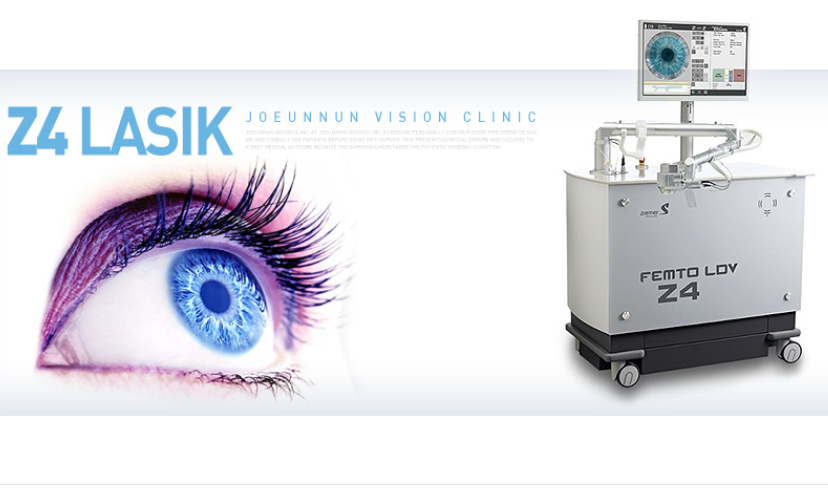
Z4 LASIK is the new generation of LASIK surgery which utilizes the most innovative laser performance called Femto LDV Z4 system developed by Ziemer company. Femto LDV Z4 has the fastest speed among femto lasers. If is 10 to 100 times faster than any other femto laser and has no tissue side effects. More precise corneal flap can be made with faster laser with smaller beam size and lower energy.

The smallest laser spot volume

Femto LDV Z4 has less than 2x2x2 cubic micrometer fine-sized laser spot volume. Such a highly accurate technology makes more precise corneal flap than any other spot laser. The risk of complication is reduced even further as compared to previous techniques.

The gentle way to restore sharp vision

Femto LDV Z4 utilizes the lowest laser pulse energy, which is in the unit of nano Joules. The laser's low energy pulse causes much less thermal damage or inflammation in the corneal bed compared to other femto lasers.


If you are interested in getting your vision corrected, you should consider having your clear vision restored by the new generation, super-fast, ultra-smooth laser performance utilized in Z4 LASIK. Kangnam Joeunnun Vision Clinic was selected as an outstanding hospital for Z4 LASIK by the Swiss Ziemer manufacturer, as the hospital has demonstrated its expertise in the field. Get more information about Z4 LASIK and other eyecare services by visiting our website or contacting us.

Refer to the following pages for more information.
Google blog: http://bit/ly/1ERE26C
Facebook page: https://www.facebook.com/lasikinkorea
English website: http://www.visionclinic.co.kr/eng

★Free Eye Exam and Consultation Request★
http://bit.ly/1D8nyFt

Emma Nam
Kangnam Joeunnun International Eye Center
dongnam2016@gmail.com
Tel: 02-535-8001 / 010-7733-3964

Monday, April 20, 2015

LASIK: Frequently Asked Questions

Q: How do I know if I'm eligible for laser vision correction?
  • You must have healthy eyes -- no glaucoma, cataracts, severe dry eye, infection, or any other condition that would affect operation.
  • Your vision must be stable for at least a year before surgery.
  • If you're pregnant or nursing, your hormonal levels can affect the shape of your eye. You should wait until your hormones are back to normal levels.
  • You cannot have a degenerative or autoimmune disease, since this would affect postoperative healing.
  • You must be an adult: age 21+ (with some exceptions).


A: Here are some general guidelines:


Your eye care practitioner can help you decide by giving you a comprehensive eye examination to make sure your eyes are healthy and you're a suitable candidate for laser vision correction surgery. He or she will check your eye power and test for glaucoma, cataracts, and other disqualifying conditions. He or she will also use a corneal topographer to photograph and electronically map your eye, and this map will be used to plan your surgery for tthe most precise results possible.

Q: Is LASIK surgery safe?

A: The FDA recognizes LASIK as proven, safe and effective. Laser vision correction uses a cool (non-thermal) beam of light that is computer controlled. The surgeon is ablel to turn the laser on and off at any moment. Further, many safeguards are in place to minimize risks.

Q: How long does LASIK take?

A: The laser surgery itself usually takes less than a minute, but the entire procedure takes approximately 15 minutes per eye. Most surgeons perform LASIK procedure on both eyes at the same time.

Q: What happens during the LASIK procedure?

A: At your surgeon's office, you will lie down in a reclining chair. The surgeon will place anesthetic drops in your eye and position your head under the laser. Your eye lids will be held wide open by an eyelid speculum (retainer). Then, the surgery begins. the surgeon creates a thin flap in the top of the cornea, folds it back out of the way, uses the laser to remove some corneal tissue and then puts the flap back in place. After the surgery, the surgeon will place eye drops or ointment in your eye. You may relax for a little while then head home and rest.

Q: How long does it take to recover?

A: Many surgeons recommend one day of rest for your eyes to recover, but most people who have LASIK go back to work the next day. You may drive as soon as you see well enough, but avoid driving on the day you have surgery. You may resume wearing eye makeup about one week after  your surgery, but throw out your old makeup to decrease the risk of infection.

Q: How many followups will I need after LASIK?

A: You will followup with your surgeon the next day of the surgery, then one week or one month later and then three months later. Your surgeon will let you know if more visits are necessary.

Q: Are there any side effects?

A:  Some people experience dry eye after LASIK, which usually is relieved with eye drops and disappears over time. A small number of patients (probably fewer than 1 percent) experience regression, a gradual worsening of vision. If this happens, consult with your eye care practitioner to examine the problem and to see if retreatment is appropriate. Kangnam Joeunun Vision Clinic is providing a lifetime care for any patient who has visited the clinic, reducing the concerns of those who are worried about the consequences after LASIK.

Q: How much does laser vision correction cost?

A: The costs vary from one surgeon to the next and depend upon the type of laser used in the procedure. The average cost for laser-based vision correction procedure in Korea is about ₩1,200,000 to ₩2,000,000 for both eyes. It is best to consult with staffs at an eye clinic about how to finance a procedure.

Have more questions about LASIK and don't know where to ask?
The absolute best source of information about LASIK is a LASIK surgeon, and Kangnam Joeunnun International Eye Center provides free consultation and free eye examination. All you have to do is make an appointment and visit!

Google blog: http://lasiklasekseoulkorea.blogspot.kr/
Facebook Page : https://www.facebook.com/lasikinkorea
English website : http://www.visionclinic.co.kr/eng

★Free Eye Exam and Consultation Request★
http://bit.ly/1D8nyFt

*Source: http://www.allaboutvision.com

Monday, April 13, 2015

Celebrities Who Had Lasik

Lasik is a type of surgery which uses lasers to reshape an individual's cornea and improve their vision. Several famous people have had Lasik eye surgery. Actors, musicians and athletes have all had the procedure. Some celebrities even filmed their experience for reality television.

Who is the most famous person who had Lasik? Kim Kardashian tops our list. The reality TV star underwent Lasik eye surgery on her show "Keeping Up with the Kardashians." She was scared about having the procedure, but her vision improved immediately. Other famous people who had their Lasik surgeries filmed include Kristin Cavallari, Jessica Simpson, and Lisa Ling.

Several professional athletes have improved their game by having Lasik eye surgery. NBA player LeBron James had Lasik eye surgery in 2007. His shooting average increased after the procedure. Professional golfer Tiger Woods had his first Lasik eye surgery in 1999 and he underwent the procedure a second time eight years later. NFL player Tiki Barber had Lasik eye surgery in 2000. He says, "It's been four years since my surgery and I've had no complications and remain thrilled with my vision."

Would you prefer to wear glasses or have Lasik eye surgery? Share your thoughts in the comments section.


Reality TV star Kim Kardashian underwent Lasik eye surgery on her show "Keeping Up with the Kardashians."


Supermodel Cindy Crawford is very happy with her Lasik surgery. She says,"The procedure was painless and I can see so much clearer now. It’s great to wake up in the middle of the night and watch television without my glasses, and, best of all, I can drive without glasses or contacts. I would recommend it to anyone."


Nicole Kidman has said of her Lasik eye surgery, “I was walking around legally blind. Now I have 20-20 vision. I can’t believe I spent so many years blurry, but I think that coincides with how I was feeling. Now I notice if people are watching me, but I also smile right back if someone waves, which helps.”


NBA player Lebron James had Lasik eye surgery in 2007.


Actor Brad Pitt had Lasik eye surgery around 2010.


Reporter Lisa Ling had her Lasik surgery live on "The View."


*Source: www.ranker.com

Kangnam Joeunnun International Eye Center is providing exceptional medical services in LASIK and LASEK laser eye surgery! Get 50 types of comprehensive and detailed eye test for FREE and see if you are a right candidate for LASIK or LASEK surgery.


Google blog: http://lasiklasekseoulkorea.blogspot.kr/
Facebook Page : https://www.facebook.com/lasikinkorea
English website : http://www.visionclinic.co.kr/eng

★Free Eye Exam and Consultation Request★
http://bit.ly/1D8nyFt