Showing posts with label Vision Correction. Show all posts

Sunday, February 28, 2016

Range of EYEPCL

Range of EYEPCL

* Asperic

Better than the best for the most superior quality of Vision Correction.
The EyePCL (Implantable Phakic Contact Lens) is manufactured with Advanced Hybrid Hydrophylic Material first time in the world. It is created by Intra Ocular Care Pvt. Ltd., Care Group India, which has been providing improved quality of vision.
The Proven track record of the EyePCL (Implantable Phakic Contact lens) provides:
• Improved quality of eye vision with sharper and clear image.
• Utmost patient satisfaction.
• Remarkably short and painless recovery.
• Pleasant Surprise which you will notice instantly, see it & experience it.
EyePCL is the preferred eye vision correction medical intervention procedure for patients who strive for the best. This medical intervention procedure is performed with highest level of expertise & by maintaining needed high safety standards to give best results in performance.

* Toric

m I a TORIC Candidate?
A Toric Lens restores the focus of the eye with pre-existing astigmatism.
The cornea is primarily responsible for focusing the light rays in our eyes. An irregular cornea which is not exactly spherical will cause spherical and cylindrical aberrations in the optical system.
A Toric EyePCL ensures correction of Spherical Aberrations in the eye while also correcting the Cylindrical errors.
A Monofocal or Spherical lens corrects only the Spherical errors and will not provide perfect quality of vision to the eye which has an irregular cornea, or in other words Astigmatism.

* Presbyopic

The Quick & Safe way to get Rid of your Reading Glasses
After approximately 40 years of age, most people find it increasingly difficult to see the near objects. This condition is known as Presbyopia and is a normal part of ageing. It develops as the lens of the eye becomes less flexible. Presbyopia should not be confused with by hyperopia or farsightedness, which is related to the size of eyeball.
The Presbyopic EyePCL Implantation is a procedure that ensures a hassle-free life, eliminating the need to use reading glasses after 40 years of age.

**source:http://epcliol.com
★Free Eye Exam and Consultation Request★
http://bit.ly/1D8nyFt
For more information, refer to the following pages.
English website: http://www.visionclinic.co.kr/eng
Facebook page: https://www.facebook.com/lasikinkorea

MOON JOO KIM
Kangnam Joeunnun International Eye Center
y0613v@hanmail.net
Tel: 02-535-8001 / 010-7793-8003

Wednesday, October 14, 2015

5 Foods for Healthy Eyes


You've probably heard that carrots and other orange-colored fruits and vegetables promote eye health and protect vision, and it's true: Beta-carotene, a type of vitamin A that gives these foods their orange hue, helps the retina and other parts of the eye to function smoothly.

But eating your way to good eyesight isn't only about beta-carotene. Though their connection to vision isn't as well-known, several other vitamins and minerals are essential for healthy eyes. Make these five foods a staple of your diet to keep your peepers in tip-top shape.


Leafy greens

They're packed with lutein and zeaxanthin—antioxidants that, studies show, lower the risk of developing macular degeneration and cataracts.

Eggs

The yolk is a prime source of lutein and zeaxanthin—plus zinc, which also helps reduce your macular degeneration risk.

Citrus and berries

These fruits are powerhouses of vitamin C, which has been shown to reduce the risk of developing macular degeneration and cataracts.

Almonds

They're filled with vitamin E, which slows macular degeneration, research shows. One handful (an ounce) provides about half of your daily dose of E.

Fatty fish

Tuna, salmon, mackerel, anchovies and trout are rich in DHA, a fatty acid found in your retina

**source:www. health.com

Thursday, July 30, 2015

Presbyopia at Joeunnun International Eye Center


Presbyopia develops gradually. You may first notice these signs and symptoms after age 40:
  • A tendency to hold reading material farther away to make the letters clearer
  • Blurred vision at normal reading distance
  • Eyestrain or headaches after reading or doing close work
You may notice these symptoms are worse if you are tired, drank alcohol or are in an area with dim lighting.
When to see a doctor
See an eye doctor if blurry close-up vision is keeping you from reading, doing close work or enjoying other normal activities. He or she can determine whether you have presbyopia and advise you of your options.
Seek immediate medical care if you:
  • Have a sudden loss of vision in one eye
  • Experience sudden hazy or blurred vision
  • See flashes of light, black spots, or halos around lights
To learn more about presbyopia, refer to the following pages for more information.
English website: http://www.visionclinic.co.kr/eng
Facebook page: https://www.facebook.com/lasikinkorea


★Free Eye Exam and Consultation Request★
http://bit.ly/1D8nyFt

MOONJOO KIM
Kangnam Joeunnun International Eye Center
y0613v@hanmail.net
Tel: 02-535-8001 / 010-7793-8003


Tuesday, July 14, 2015

WHY CHOOSE US?


 WHY CHOOSE US?


1. Fewer adverse effect

Our center has not had medical disputes with our customers by complications from corneal opacity. corneal ectasia,infection so on ever since we opended the center in 2007. It is the valuable result by intensive eye exam. upgraded surgical equipments and considering personal information before the surgery such as life style,hobby,job,age,etc.

 2. Safe surgery as highest priority

many patients prefer simple and easy procedures as well as a fasr recovery.
however, JOEUNNUN VISION CLINIC persists in thorough exams and safe and high-quality surgical procedure. This is because we put safe surgery as the highest priority, not convenience.

 3. Respect for every patient

At JOEUNNUN VISION CLINIC, surgeons personally check-up every prreoperative exam and
consult the patients before going into surgery. This prevents surgical errors and secures the best medical outcome because the surgeon understandins the patients' general condition.
 
                                                                                              
                                                                  continue....
★Free Eye Exam and Consultation Request★
http://bit.ly/1D8nyFt


MOONJOO KIM
Kangnam Joeunnun International Eye Center
y0613v@hanmail.net
Tel: 02-535-8001 / 010-7793-8003


Friday, June 26, 2015

All-Laser AMARIS 750s LASEK at Kangnam Joeunnun International Eye Clinic

What is special about All-Laser AMARIS LASEK?

In all-laser LASEK, only Schwind AMARIS 750s laser is used throughout the procedure. Since no physical or chemical methods, such as knife, brush, or alcohol are used during corneal epithelial removal, there is no physical or chemical contact with the cornea. The laser is programmed for individual prescription, and the surface of the cornea under the epithelium is lasered for vision correction.


Major advantages of All-Laser AMARIS LASEK

  • In All-Laser LASEK, only AMARIS 750s laser is used to ablate both the corneal epithelium and stroma all at once.
  • There is no risk of physical damage in the corneal stroma because knife, brush, or epithelial isolator is not used during the procedure.
  • There is no risk of chemical stimulation, inflammation, or toxicity because alcohol or any type of chemicals is not used during the procedure.
  • There is no risk of infection and surgical error because the surgery is hands-free and is performed solely by the most advanced laser.
  • The epithelium is not overly removed because the location and the shape of the removal area are precisely designed by laser.
  • Only the necessary, mininum amount of epithelium is removed. Therefore, it has relatively fast recovery time and less pain.
  • With AMARIS laser about 50-100% faster than other types of laser, it has very short laser ablation time even if the epithelium and stroma are all removed.

All-laser LASEK procedure

The surgical procedure is very simple, so there are almost no surgical variables.
  1. Topical anesthesia is applied to both eyes.
  2. Laser cuts the corneal epithelium and stroma successively.
  3. The surgery is completed after the therapeutic lenses are put on.


Kangnam Joeunnun International Eye Clinic is offering a huge promotion on All-Laser LASEK throughout this summer. If you have questions about the LASEK procedure and its cost, please contact us by visiting our website or via contact information below.

 ★Free Eye Exam and Consultation Request★
http://bit.ly/1D8nyFt
For more information, refer to the following pages.
English website: http://www.visionclinic.co.kr/eng
Facebook page: https://www.facebook.com/lasikinkorea

Emma Nam
Kangnam Joeunnun International Eye Center
dongnam2016@gmail.com
Tel: 02-535-8001 / 010-7733-3964

Thursday, June 18, 2015

MEL90 Saving LASIK/LASEK for Vision Correction

MEL 90, the newer generation excimer laser

An excimer laser is a precise computerised intrument using invisible cool UV light to change the corneal shape. This cool light laser technique is a safe process and does not affect the surrounding tissue. Each pulse of the laser removes only a minute amount of corneal tissue.
The MEL 90 utilizes innovative technology: a narrow beam (about 0.7mm wide) contacts the eye at lightning speed in a pattern that allows the debris to clear in one place before contacting that area again. This technology produces a smoother corneal shape and helps increase the accuracy and efficiency of the surgery. The MEL 90 is equipped with an active eye tracker with an excellent response time to provide high-level treatment safety with very stable results.

At Kangnam Joeunnun International Eye Center, we have been using this new Zeiss excimer laser MEL 90 for refractive eye surgery. Unique product like the FLEXIQUENCE switch function, the ablation profile Triple-A and the outstanding intra-operative ablation speed up to 1.3 seconds per diopter create entirely new treatment prospects.

FLEXIQUENCE - Applied flexibility

The FLEXIQUENCE switch function lets you flexibly choose between 250Hz and 500Hz frequency. You can have twice the speed in a fraction of a second with a simple touch of the finger - enabling you to leverage both proven reliability and new treatment opportunities.


Triple-A Advanced Ablation Algorithm

The MEL 90 also features the Triple-A Advanced Ablation Algorithm. As a single ablation profile for a widde range of sphero-cylindrical (SCA) corrections, it simplifies treatment planning. Triple-A offers a high degree of precision and predictability. It comprises an aspherically opimized design that also focuses on minimal tissue removal.


Comparison of the amount of tissue removal

Are you the right candidate for LASIK/LASEK?

To figure out which refractive surgery procedure is best suited to you, you would need to go through a comprehensive eye examination. If you are considering vision correction, try FREE eye examination and consultation at Kangnam Joeunnun International Eye Center.
 
 ★Free Eye Exam and Consultation Request★
http://bit.ly/1D8nyFt
For more information, refer to the following pages.
English website: http://www.visionclinic.co.kr/eng
Facebook page: https://www.facebook.com/lasikinkorea

Emma Nam
Kangnam Joeunnun International Eye Center
dongnam2016@gmail.com
Tel: 02-535-8001 / 010-7733-3964


 *source: www.zeiss.com

Friday, June 12, 2015

Do I qualify for LASIK?

Are you the right candidate for LASIK?

Most people who have healthy eyes and have mild to moderate refractive errors (nearsightedness, farsightedness, or astigmatism) are good candidates for LASIK vision correction surgery. However, there are possible reasons that LASIK surgery might not be the right choice for you include:
  • Unstable vision. LASIK is usually not recommended for teenagers under 18 because their vision often is still changing. You vision should be stable for at least one to two years before having LASIK surgery
  • Dry eyes. Both the quality and the quantity of tears you produce are factors in the development of dry eyes, which also can affect healing after the surgery. You will undergo screening exam in advance of LASIK procedure to check for dry eyes.
  • Keratoconus or other corneal thinning disorders.
  • Other eye problems such as cataracts, advanced glaucoma, past ocular herpes infections, and eye problems caused by other health problems such as diabetes.
  • Immune system disorders such as rheumatoid arthritis, lupus, collagen vascular disease, multiple sclerosis, myasthenia gravis and AIDS. Use of medications such as steroids and immunosuppressants can slow or prevent proper healing of eyes after LASIK.

51 Preoperative Tests offered at Kangnam Joeunnun International Eye Center

At Kangnam Joeunnun Vision Clinic, we will examine your eye status in detail before we determine which type of eye surgery will be the best for you. The preoperative eye examination include 51 types of tests, and it takes about one and half hour to two hours which shows how comprehensive and thorough the exam is. This is not a simple eye test you could get at a hospital, this will gaurantee your safety and the best result in any surgery you undergo.


★Free Eye Exam and Consultation Request★
http://bit.ly/1D8nyFt
For more information, refer to the following pages.
English website: http://www.visionclinic.co.kr/eng
Facebook page: https://www.facebook.com/lasikinkorea

Emma Nam
Kangnam Joeunnun International Eye Center
dongnam2016@gmail.com
Tel: 02-535-8001 / 010-7733-3964

*source: www.allaboutvision.com

Tuesday, June 2, 2015

Presbyopia Surgery Center at Kangnam Joeunnun Vision Clinic in Seoul, Korea

Even if you undergo LASIK and LASEK surgery as a young person and achieve perfect vision, you still will develop a condition called presbyopia, typically beginning between the ages of 40 and 50.
Presbyopia is the inability of the eye to focus at all distances, usually noticed when fine print starts to blur. In the past, the usual remedy was to wear reading glasses or special multifocal lenses (bifocal or progressive lenses) for presbyopia. But thesedays, a variety of options for surgical remedies also are available for qualified candidates.

Custom Laser Presbyopia Surgery

Custom laser presbyopia surgery is the surgical method that can effectively correct presbyopia by LASIK and LASEK. One of the first effective surgical options for presbyopia correction involve producing "monovision" during LASIK. Monovision method makes the dominant eye to have good far vision, and the nondominant eye to have near vision. Human brain adapts to the perception difference for a certain period post operation. Another method is "multifocality" which is a method of making the cornea have aspherical shape like the multifocal lens so it has clear vision in all directions.
Custom Laser presbyopia surgery uses both the monovision and multifocal method. Presbyopia correction by monovision method is effective but the correction range is limited due to the discomfort felt from the disparity of eyesight in each eye. Multifocal method maintains symmetric balance in both eyes but decreases near vision. Custom laser laser presbyopia makes the focal point deeper by cutting off the aspherical cornea using the iris recognizing wavefront while maintainig some degree of myopia in the non-dominant side. It uses both monovision and multifocality to overcome the limitations of each method and to recover the near-sighted vision without discomfort.

PresbyMAX Laser Presbyopia Surgery at Kangnam Joeunnun Vision Clinic

PresbyMAX Hybrid is a minimally invasive method for the treatment of presbyopia using the cutting-edge technology of the SCHWIND AMARIS eye laser systems. A different depth of focus is generated in the dominant and non-dominant eye. This ensures an extremely fast visual recovery and an especially high quality of distance vision.


Major benefits include:

  • A faster visual recovery of visual acquity
  • Particularly high quality of vision at all distances
  • Good spatial vision
  • Permanent presbyopia correction by a single surgery
  • Precise dianosis of various optical conditions through a comprehensive eye examination prior to surgery

To learn more about presbyopia-correcting surgical options, refer to the following pages for more information.
English website: http://www.visionclinic.co.kr/eng
Facebook page: https://www.facebook.com/lasikinkorea


★Free Eye Exam and Consultation Request★
http://bit.ly/1D8nyFt

Emma Nam
Kangnam Joeunnun International Eye Center
dongnam2016@gmail.com
Tel: 02-535-8001 / 010-7733-3964

*source: www.allaboutvision.com

Thursday, May 28, 2015

Why You Should Choose All-Laser Lasik

Traditional LASIK vs. All-laser LASIK

The most important step in custom laser vision correction surgery is the creation of a flap. In order to reach the inner cornea to correct your viison, the doctor must first lift the very thin top layer of your cornea. How that is accomplilshed is the real difference between these two types of surgery.

With traditional LASIK this layer is create by using a blade, known as microkeratome. This hand-held device makes a cut on the eye so when the flap is lifted, there is a hinge created.

With custom all-laser LASIK like that found at Kangnam Joeunnun Vision Clinic, the flap is created by using a computer-guided femtosecond laser. Tiny pulses of infrared light are used to create a series of bubbles that separate the tissues, and the femptosecond laser technology creates the customized flap dimensions and enables the surgeon to create and then lift a highly precise flap with a consistent thickness. This advanced technology is a safer and more precise way to reach the cornea.


Other Advantages of All-laser LASIK

  • There are fewer complications while making the flap like flap displacement
  • There is lower intraocular pressure when creating a flap with a femtosecond laser
  • There is greater flap stability
  • There is virtually no chance of infection or inflammation using a laser
  • Certain patients who could not have LASIK before due to thin corneas, can now have their vision corrected with custom all-laser LASIK 

The Most Important Part of Surgery - Choosing Surgical Expertise and Experienced Surgeon

The most advanced surgical equipment does not take the place of a doctor's surgical skills and expertise gained from ample experience. At Kangnam Joeunnun International Eye Center in Seoul, Korea we have both skilled and experienced doctor and the most advanced technology for laser vision correction surgeries. The doctor and professsional staff are dedicated to improving your vision and providing life-time eye care for whoever visits the clinic. Dr. Kim has been acknowledged as a leading surgeon in LASIK and LASEK refractive eye surgeries in Korea, and you can trust his expertise and skill in selecting the best option for your custom all-laser LASIK. For your best vision, schedule FREE comprehensive eye examination and consultation at Kangnam Joeunnun Vision Clinic today.

Refer to the following pages for more information.
Google blog: http://bit/ly/1ERE26C
Facebook page: https://www.facebook.com/lasikinkorea
English website: http://www.visionclinic.co.kr/eng

★Free Eye Exam and Consultation Request★
http://bit.ly/1D8nyFt

Emma Nam
Kangnam Joeunnun International Eye Center
dongnam2016@gmail.com
Tel: 02-535-8001 / 010-7733-3964


*source: www.clearviewinstitute.com

Tuesday, May 19, 2015

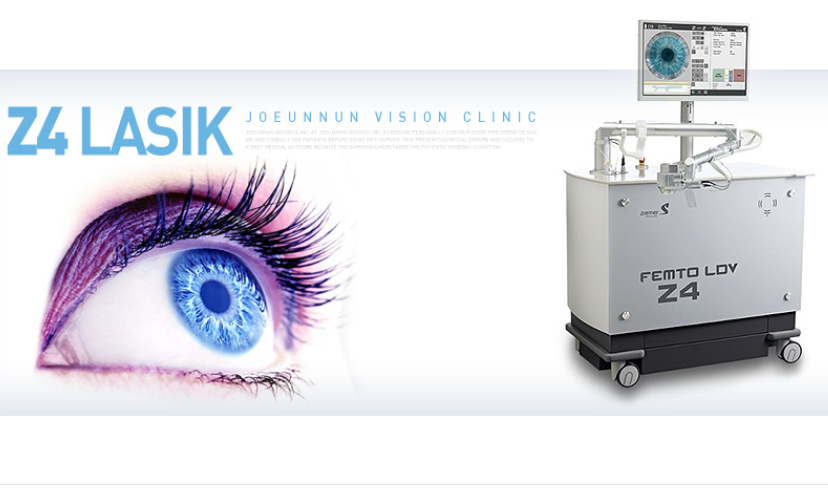
Restore Sharp Vision by Z4 LASIK

If you are looking for safe, accurate and comfortable laser eye surgery to correct your vision, Z4 LASIK is the procedure of choice you should consider.


The fastest laser performance

Z4 LASIK is the new generation of LASIK surgery which utilizes the most innovative laser performance called Femto LDV Z4 system developed by Ziemer company. Femto LDV Z4 has the fastest speed among femto lasers. If is 10 to 100 times faster than any other femto laser and has no tissue side effects. More precise corneal flap can be made with faster laser with smaller beam size and lower energy.

The smallest laser spot volume

Femto LDV Z4 has less than 2x2x2 cubic micrometer fine-sized laser spot volume. Such a highly accurate technology makes more precise corneal flap than any other spot laser. The risk of complication is reduced even further as compared to previous techniques.

The gentle way to restore sharp vision

Femto LDV Z4 utilizes the lowest laser pulse energy, which is in the unit of nano Joules. The laser's low energy pulse causes much less thermal damage or inflammation in the corneal bed compared to other femto lasers.


If you are interested in getting your vision corrected, you should consider having your clear vision restored by the new generation, super-fast, ultra-smooth laser performance utilized in Z4 LASIK. Kangnam Joeunnun Vision Clinic was selected as an outstanding hospital for Z4 LASIK by the Swiss Ziemer manufacturer, as the hospital has demonstrated its expertise in the field. Get more information about Z4 LASIK and other eyecare services by visiting our website or contacting us.

Refer to the following pages for more information.
Google blog: http://bit/ly/1ERE26C
Facebook page: https://www.facebook.com/lasikinkorea
English website: http://www.visionclinic.co.kr/eng

★Free Eye Exam and Consultation Request★
http://bit.ly/1D8nyFt

Emma Nam
Kangnam Joeunnun International Eye Center
dongnam2016@gmail.com
Tel: 02-535-8001 / 010-7733-3964

Sunday, May 3, 2015

Dry Eyes and LASIK

About half of patients who had LASIK surgery tend to report having dry eyes after the surgery. While the condition is temporary and mild, significant numbers of people continue to have dry eyes for months or even years after a procedure.

But to keep the problem in perspective, many people who seek LASIK already have dry eyes. For instance, contact lens wearers who find their lenses uncomfortable because of dry eyes may investigate laser vision correction surgery as an alternative.

How Does LASIK Cause Dry Eyes?

In certain cases, LASIK and other vision correction procedures can cause dry eyes after they penetrate the eye's surface and reduce corneal nerve sensitivity. Inadequate tear production results when your eyes then fail to sense the need for lubrication.

Dry eyes after LASIK can cause not only discomfort but less than optimal visual outcomes. For this reason, many eye surgeons recommend that you use lubricating eye drops or other treatments to help maintain eye moisture in advance of a LASIK procedure even if you don't have any sign of dry eyes.

Dry eye condition can be detected by monitoring the quality and the quantity of tears you produce. Such screening can be done during the comprehensive eye examination which precedes a LASIK procedure in order to assess you as a possible candidate for LASIK. Having dry eyes prior to a LASIK procedure will not automatically eliminate you as a candidate. But your eye doctor will need to consider the severity of your condition and the possibility of effective treatment before recommending a procedure.

Treatment of Dry Eyes Before and After LASIK

Your eye doctor may treat you for dry eyes prior to a LASIK procedure as a precaution, even your tear production is normal. You may be advised to take flaxseed oil or fish oil orally for several weeks before your vision correction surgery to improve your tear film. You also may need to use lubricating eye drops before and after a LASIK procedure.

After LASIK, your surgeon may recommend prescription eye drops such as Cyclosporine (Restasis) that help your body formulate tears. Cyclosporine actually has been found to quicken the recovery of corneal sensitivity after LASIK an thus return the eye to normal moisture. Furthermore, other common dry eye remedies include punctal plugs, which block tear drainage channels to increase moisture on the eye, and anti-inflammatory medications such as corticosteroids administered as eye drops.

Studies indicate that taking omega-3 fatty acid supplements and eating food containing these "good fats," such as salmon, can help maintain a healthy tear film. Drinking plenty of water also can keep your body and your eyes properly hydrated.

Again, keep in mind that many dry eye symptoms following a refractive surgery procedure usually are relatively mild and disappear in time. It is best to be aware of the possibility of developing such a condition so that you will be prepared to prevent it before and after getting LASIK done.


If your considering getting a vision correction surgery in Korea and are concerned about your eye condition including dry eyes, feel free to consult with our staff at Kangnam Joeunnun International Eye Center. A thorough eye examination prior to choosing a treatment option is essential to maximize surgery outcomes and minimize side-effects. Get a free eye exam and consultation at our hospital where our experienced doctor provides exceptional medical services in LASIK and LASEK eye surgery.

Refer to the following pages for more information.
Google blog: http://bit/ly/1ERE26C
Facebook page: https://www.facebook.com/lasikinkorea
English website: http://www.visionclinic.co.kr/eng

★Free Eye Exam and Consultation Request★
http://bit.ly/1D8nyFt

Emma Nam
Kangnam Joeunnun International Eye Center
dongnam2016@gmail.com
Tel: 02-535-8001 / 010-7733-3964


*Source: www.allaboutvision.com

Monday, April 20, 2015

All About Presbyopia - Age-Related Farsightedness

What is Presbyopia?

Presbyopia is defined as the loss of the eye's ability to change focus to see near objects. It is a vision disorder that develops as we age. This condition occurs at approximately 40 years of age. Everyone will eventually develop presbyopia.
 

Signs and Symptoms

The main symptom is the inability to focus on near objects, such as small print on a medicine bottle or in a phone book. Holding print out futher seems to make it easier to read. Patients may complain of needing more light to read, as contrasting ability decreases. Presbyopic eyes also feel fatigues and seem to tire more easily. Some presbyopic patients may also have fluctuating vision, as their eyes are attempting to overcompensate for vision deficit.
 

Causes

Presbyopia is caused by an age-related process. As we age, the lens inside the eye gradually loses its flexibility, making it harder to focus up close. Although it seems to come on suddenly in the early fories, in reality the eye slowly loses its near focusing power throughout life. Prespyopia worsens slowly to about the age of 65, when most reserve focusing power is lost.


Diagnosis

Diagnosis of presbyopia is made by undergoing a comprehensive eye examination. Your eye doctor will measure your amplitude of accomodation, or reserve near focusing power, and perform a simple refractive test to reveal the condition.
 

Treatment

There is no way to prevent presbyopia as it is a natural aging process, but it is easily treated. Your eye doctor may prescribe reading glasses, bifocals or progressive addition lenses to correct presbyopia. Patients may also decide to be corrected with certain contact lenses, such a multifocal and mono vision contactt lensees. Others may choose to undergo refractive surgical procedure, such as monovision laser vision correction (LASIK). Furthermore, multifocal intraocular lens implants are available to patients.


Kangnam Joeunnun Vision Clinic is 'Republic of Korea Custormer Satisfaction Brand Award 2015' in the ophthalmic division (presbyopia correction). The clinic provides a wide range of high-quality treatments for presbyopia from laser eye surgery to intraocular lens implants.
 
Refer to the following pages for more information.
Google blog: http://bit/ly/1ERE26C
Facebook page: https://www.facebook.com/lasikinkorea
English website: http://www.visionclinic.co.kr/eng

★Free Eye Exam and Consultation Request★
http://bit.ly/1D8nyFt

Feel free to contact us anytime :)

Emma Nam
Kangnam Joeunnun International Eye Center
dongnam2016@gmail.com
Tel: 02-535-8001 / 010-7733-3964


*Source: www.about.com/health

LASIK: Frequently Asked Questions

Q: How do I know if I'm eligible for laser vision correction?
  • You must have healthy eyes -- no glaucoma, cataracts, severe dry eye, infection, or any other condition that would affect operation.
  • Your vision must be stable for at least a year before surgery.
  • If you're pregnant or nursing, your hormonal levels can affect the shape of your eye. You should wait until your hormones are back to normal levels.
  • You cannot have a degenerative or autoimmune disease, since this would affect postoperative healing.
  • You must be an adult: age 21+ (with some exceptions).


A: Here are some general guidelines:


Your eye care practitioner can help you decide by giving you a comprehensive eye examination to make sure your eyes are healthy and you're a suitable candidate for laser vision correction surgery. He or she will check your eye power and test for glaucoma, cataracts, and other disqualifying conditions. He or she will also use a corneal topographer to photograph and electronically map your eye, and this map will be used to plan your surgery for tthe most precise results possible.

Q: Is LASIK surgery safe?

A: The FDA recognizes LASIK as proven, safe and effective. Laser vision correction uses a cool (non-thermal) beam of light that is computer controlled. The surgeon is ablel to turn the laser on and off at any moment. Further, many safeguards are in place to minimize risks.

Q: How long does LASIK take?

A: The laser surgery itself usually takes less than a minute, but the entire procedure takes approximately 15 minutes per eye. Most surgeons perform LASIK procedure on both eyes at the same time.

Q: What happens during the LASIK procedure?

A: At your surgeon's office, you will lie down in a reclining chair. The surgeon will place anesthetic drops in your eye and position your head under the laser. Your eye lids will be held wide open by an eyelid speculum (retainer). Then, the surgery begins. the surgeon creates a thin flap in the top of the cornea, folds it back out of the way, uses the laser to remove some corneal tissue and then puts the flap back in place. After the surgery, the surgeon will place eye drops or ointment in your eye. You may relax for a little while then head home and rest.

Q: How long does it take to recover?

A: Many surgeons recommend one day of rest for your eyes to recover, but most people who have LASIK go back to work the next day. You may drive as soon as you see well enough, but avoid driving on the day you have surgery. You may resume wearing eye makeup about one week after  your surgery, but throw out your old makeup to decrease the risk of infection.

Q: How many followups will I need after LASIK?

A: You will followup with your surgeon the next day of the surgery, then one week or one month later and then three months later. Your surgeon will let you know if more visits are necessary.

Q: Are there any side effects?

A:  Some people experience dry eye after LASIK, which usually is relieved with eye drops and disappears over time. A small number of patients (probably fewer than 1 percent) experience regression, a gradual worsening of vision. If this happens, consult with your eye care practitioner to examine the problem and to see if retreatment is appropriate. Kangnam Joeunun Vision Clinic is providing a lifetime care for any patient who has visited the clinic, reducing the concerns of those who are worried about the consequences after LASIK.

Q: How much does laser vision correction cost?

A: The costs vary from one surgeon to the next and depend upon the type of laser used in the procedure. The average cost for laser-based vision correction procedure in Korea is about ₩1,200,000 to ₩2,000,000 for both eyes. It is best to consult with staffs at an eye clinic about how to finance a procedure.

Have more questions about LASIK and don't know where to ask?
The absolute best source of information about LASIK is a LASIK surgeon, and Kangnam Joeunnun International Eye Center provides free consultation and free eye examination. All you have to do is make an appointment and visit!

Google blog: http://lasiklasekseoulkorea.blogspot.kr/
Facebook Page : https://www.facebook.com/lasikinkorea
English website : http://www.visionclinic.co.kr/eng

★Free Eye Exam and Consultation Request★
http://bit.ly/1D8nyFt

*Source: http://www.allaboutvision.com

Monday, April 13, 2015

Celebrities Who Had Lasik

Lasik is a type of surgery which uses lasers to reshape an individual's cornea and improve their vision. Several famous people have had Lasik eye surgery. Actors, musicians and athletes have all had the procedure. Some celebrities even filmed their experience for reality television.

Who is the most famous person who had Lasik? Kim Kardashian tops our list. The reality TV star underwent Lasik eye surgery on her show "Keeping Up with the Kardashians." She was scared about having the procedure, but her vision improved immediately. Other famous people who had their Lasik surgeries filmed include Kristin Cavallari, Jessica Simpson, and Lisa Ling.

Several professional athletes have improved their game by having Lasik eye surgery. NBA player LeBron James had Lasik eye surgery in 2007. His shooting average increased after the procedure. Professional golfer Tiger Woods had his first Lasik eye surgery in 1999 and he underwent the procedure a second time eight years later. NFL player Tiki Barber had Lasik eye surgery in 2000. He says, "It's been four years since my surgery and I've had no complications and remain thrilled with my vision."

Would you prefer to wear glasses or have Lasik eye surgery? Share your thoughts in the comments section.


Reality TV star Kim Kardashian underwent Lasik eye surgery on her show "Keeping Up with the Kardashians."


Supermodel Cindy Crawford is very happy with her Lasik surgery. She says,"The procedure was painless and I can see so much clearer now. It’s great to wake up in the middle of the night and watch television without my glasses, and, best of all, I can drive without glasses or contacts. I would recommend it to anyone."


Nicole Kidman has said of her Lasik eye surgery, “I was walking around legally blind. Now I have 20-20 vision. I can’t believe I spent so many years blurry, but I think that coincides with how I was feeling. Now I notice if people are watching me, but I also smile right back if someone waves, which helps.”


NBA player Lebron James had Lasik eye surgery in 2007.


Actor Brad Pitt had Lasik eye surgery around 2010.


Reporter Lisa Ling had her Lasik surgery live on "The View."


*Source: www.ranker.com

Kangnam Joeunnun International Eye Center is providing exceptional medical services in LASIK and LASEK laser eye surgery! Get 50 types of comprehensive and detailed eye test for FREE and see if you are a right candidate for LASIK or LASEK surgery.


Google blog: http://lasiklasekseoulkorea.blogspot.kr/
Facebook Page : https://www.facebook.com/lasikinkorea
English website : http://www.visionclinic.co.kr/eng

★Free Eye Exam and Consultation Request★
http://bit.ly/1D8nyFt